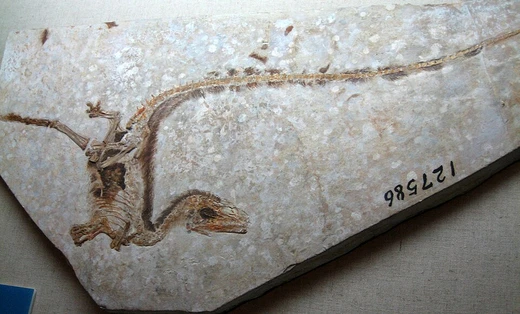
Archaeopteryx
A transitional fossil between non-avian dinosaurs and birds.

Evobio12a · CC BY 4.0
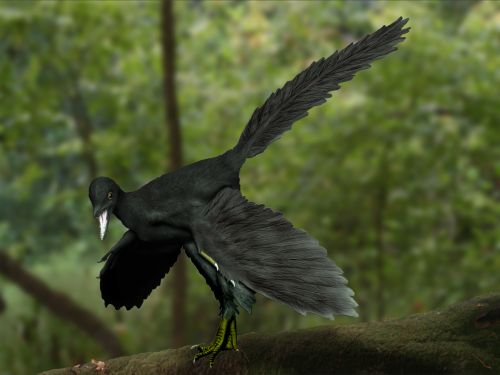
Archaeopteryx (lit. 'ancient wing'), sometimes referred to by its German name 'Urvogel' (lit. 'Primeval Bird'), is an extinct genus of bird-like dinosaurs. The genus name derives from the Ancient Greek ἀρχαῖος (archaîos), meaning 'ancient', and πτέρυξ (ptérux), meaning 'feather, wing'. Between the late 19th century and the early 21st century, Archaeopteryx was generally accepted by palaeontologists and popular reference books as the oldest known bird (member of the group Avialae). Older potential avialans have since been identified, including Anchiornis, Xiaotingia, Aurornis, and Baminornis.
- Location
- What is now southern Germany
- Size
- Similar to a Eurasian magpie; largest species up to about 50 cm (20 in) in length
- Notable features
- Feathers, sharp teeth, three fingers with claws, long bony tail, hyperextensible second toe
- Number of known body fossils
- 14
- Type specimen location
- Natural History Museum of Berlin
Lore & Background
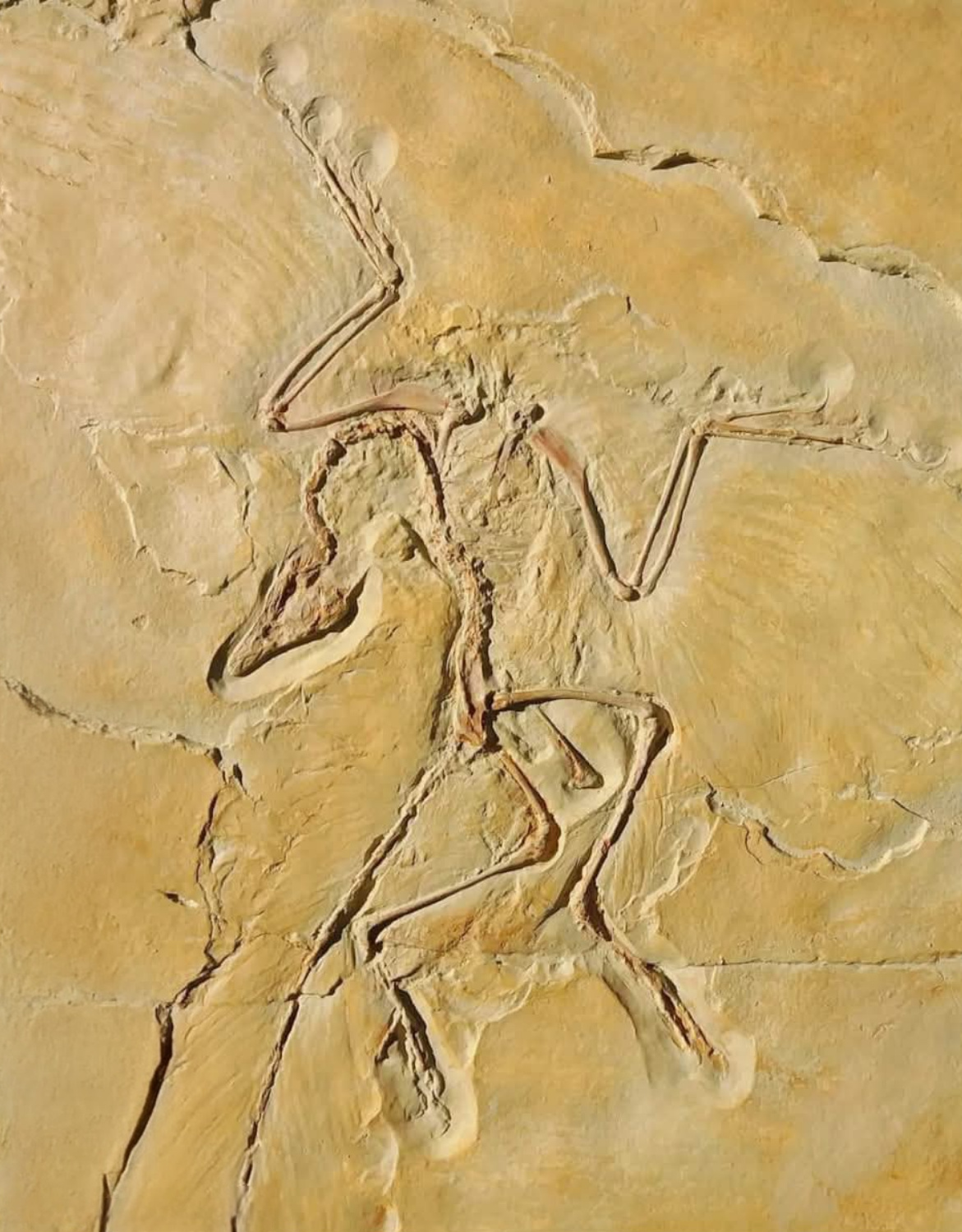
That same year, the first complete specimen of Archaeopteryx was announced. Over the years, twelve more fossils of Archaeopteryx have surfaced. Despite variation among these fossils, most experts regard all the remains that have been discovered as belonging to a single species or at least genus, although this is still debated. It is now in the Natural History Museum of Berlin. Though it was the initial holotype, there were indications that it might not have been from the same animal as the body fossils. This conclusion was challenged in 2020 as being unlikely; the feather was identified on the basis of morphology as most likely having been an upper major primary covert feather.
Reader's Guide
Archaeopteryx plays an important role, not only in the study of the origin of birds, but in the study of dinosaurs. It was discovered just two years after Charles Darwin published On the Origin of Species. Archaeopteryx seemed to confirm Darwin's theories and has since become a key piece of evidence for the origin of birds, the transitional fossils debate, and confirmation of evolution. Archaeopteryx was long considered to be the beginning of the evolutionary tree of birds. However, in recent years, the discovery of several small, feathered dinosaurs has created a mystery for palaeontologists, raising questions about which animals are the ancestors of modern birds and which are their relatives. Despite their small size, broad wings, and inferred ability to fly or glide, Archaeopteryx had more in common with other small Mesozoic dinosaurs than with modern birds. In particular, they shared features with the dromaeosaurids and troodontids: jaws with sharp teeth, three fingers with claws, a long bony tail, hyperextensible second toes ('killing claw'), feathers (which also suggest warm-bloodedness), and various features of the skeleton. These features make Archaeopteryx a clear candidate for a transitional fossil between non-avian dinosaurs and avian dinosaurs (birds).
The Solnhofen Quarry and a Century of Specimens
Every one of the fourteen known body fossils of Archaeopteryx has been recovered from limestone quarries near Solnhofen in southern Germany, sediments that local workers had been cutting for stone before palaeontology gave the deposits new significance. A 2020 rebuttal countered that the morphology was consistent with an upper major primary covert feather, leaving the question unresolved. Twelve additional specimens have since been recovered, including the Berlin Specimen, found by farmer Jakob Niemeyer near Eichstätt and eventually acquired by Berlin's museum for twenty thousand Goldmark.
A Dinosaur Wearing a Bird's Coat
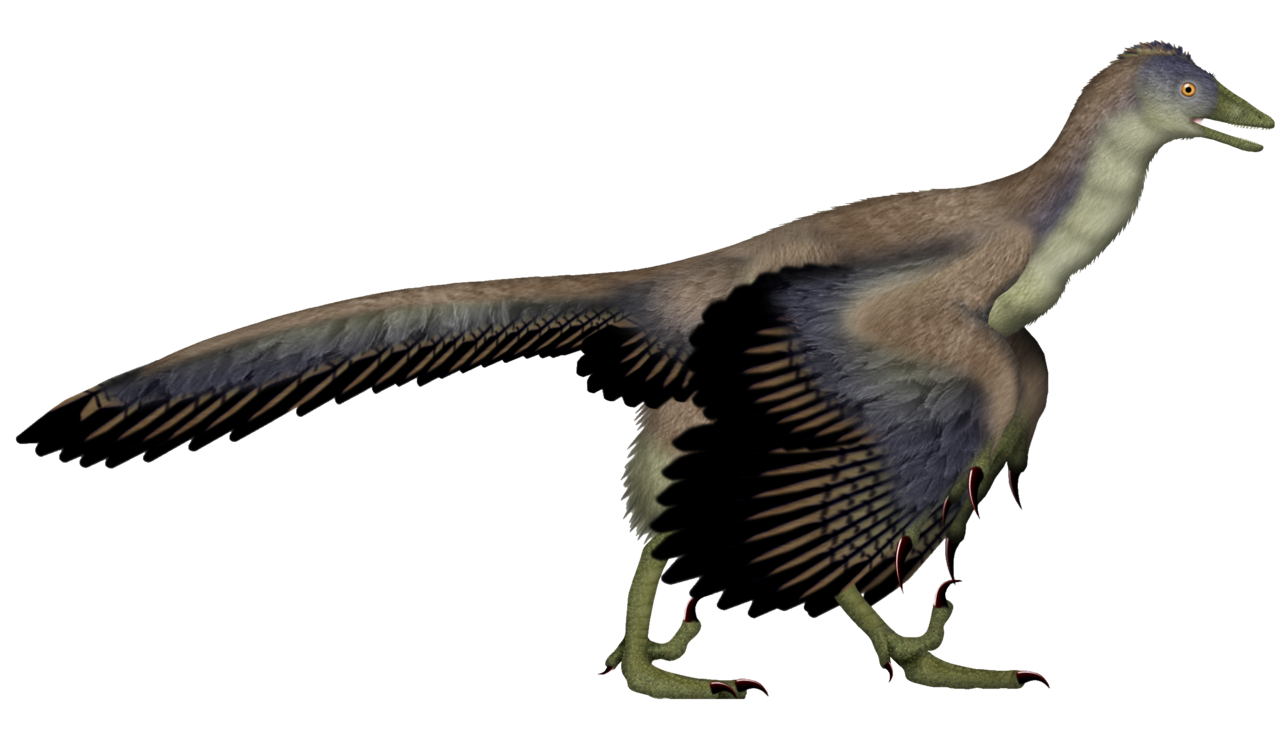
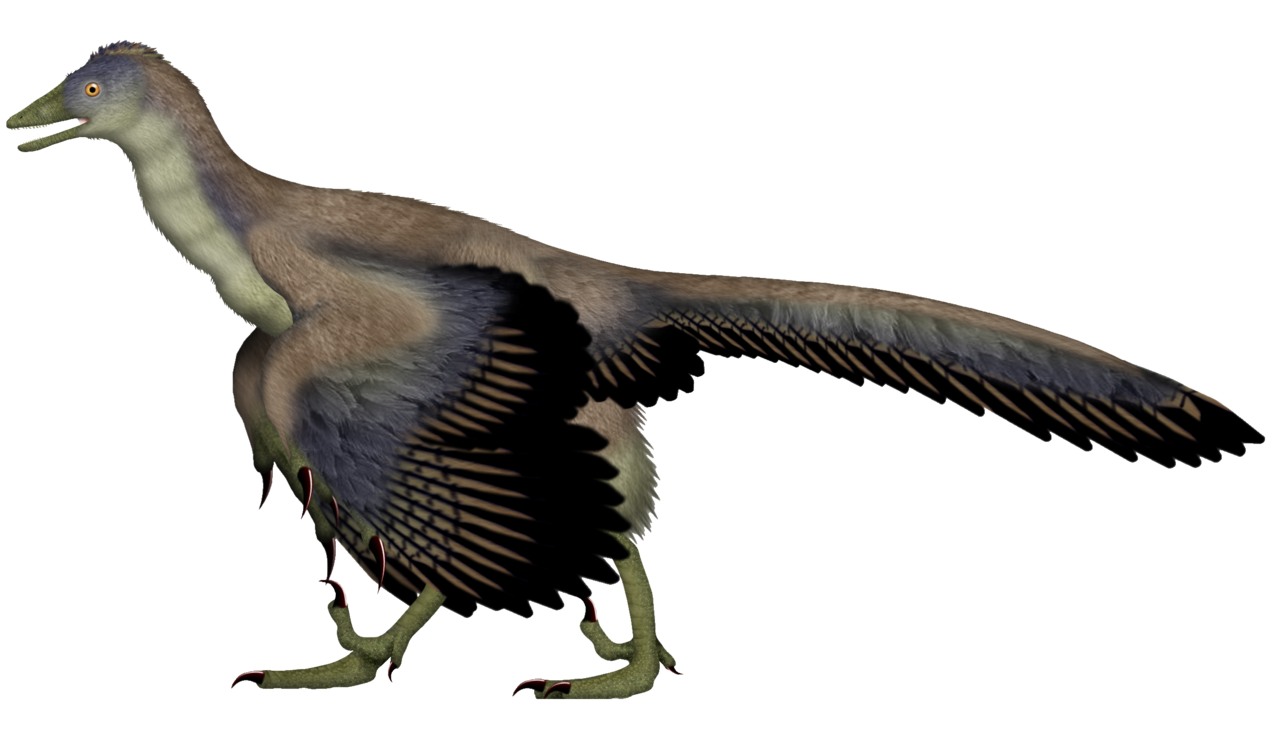
Despite its name and its broad, feathered wings, Archaeopteryx was anatomically closer to small Mesozoic theropod dinosaurs than to any modern bird. Roughly the size of a Eurasian magpie, with the largest individuals perhaps reaching raven proportions and about fifty centimetres in length, it possessed jaws lined with sharp teeth, three clawed fingers on each hand, and a long bony tail — features entirely foreign to living avians. Its second toe could hyperextend, a trait palaeontologists call the "killing claw," shared with dromaeosaurids and troodontids. Yet it also bore advanced flight feathers and broad wings that suggest it could at least glide, and the presence of feathers implies warm-bloodedness. This mosaic of reptilian and avian characteristics is precisely what makes Archaeopteryx such a compelling transitional fossil: it sits squarely on the evolutionary bridge between non-avian dinosaurs and the lineage that would eventually produce modern birds. Most of the fourteen fossils preserve feather impressions, and because those feathers are of an advanced flight-remex type, they demonstrate that the evolution of complex plumage had already begun before the Late Jurassic.
Darwin's Rosy-Fingered Morning
The timing could not have been more fortuitous for the new theory of evolution by natural selection. He highlighted the creature's long lizard-like tail with feathers on each joint and its wings bearing two free claws, using it to dismantle the argument that birds had appeared suddenly in the Eocene. For over a century, Archaeopteryx became the poster child for transitional fossils and a key piece of evidence confirming that birds evolved from dinosaurs. It anchored the public and scientific imagination in the idea that evolution was not merely a hypothesis but a process observable in the rock record, linking the ancient reptilian world to the avian one through a single, extraordinary creature.
Dethroned but Not Diminished
From the late nineteenth century through the early twenty-first, Archaeopteryx held the title of the oldest known bird, the basal member of Avialae, in both professional palaeontology and popular reference books. That throne has since been shaken. The discovery of smaller, feathered dinosaurs such as Anchiornis, Xiaotingia, Aurornis, and Baminornis has pushed the origin of avialans further back in time and raised a new puzzle: which of these creatures are true ancestors of modern birds, and which are merely close relatives? The question of whether all fourteen Archaeopteryx fossils represent a single species or at least a single genus remains debated among experts, despite most leaning toward the latter. Yet the dethronement has not diminished Archaeopteryx's importance. It remains a clear transitional form between non-avian and avian dinosaurs, and it continues to play a central role not only in understanding the origin of birds but in the broader study of dinosaur evolution. Its feathers, its claws, its teeth, and its long tail still tell the story of a world in transition.
Common Misconceptions (Editorial)
One common misconception is that Archaeopteryx is definitively the oldest known bird. However, older potential avialans such as Anchiornis, Xiaotingia, Aurornis, and Baminornis have since been identified. Another misconception is that all Archaeopteryx fossils belong to multiple distinct species; in fact, most experts regard all the remains as belonging to a single species or at least genus, though this is still debated.
Why It Matters (Editorial)
Archaeopteryx endures as a cultural and scientific icon because it captures a pivotal moment in evolution, bridging the gap between non-avian dinosaurs and modern birds. Its exquisite fossils, complete with feathers and reptilian traits like teeth and a long bony tail, continue to fuel debate about the origins of flight and the messy process of evolutionary transition, making it a touchstone for both paleontologists and the public.
Gallery
Frequently Asked Questions
What does Archaeopteryx look like and how big was it?
It was about the size of a Eurasian magpie, with the largest specimens reaching around 50 cm in length. Despite its feathers, it still had sharp teeth, three clawed fingers, a long bony tail, and a hyperextensible second toe—features that blend dinosaur and bird anatomy.
Is Archaeopteryx still considered the oldest bird?
For most of the 20th century it held that title, but newer discoveries such as Anchiornis, Xiaotingia, Aurornis, and Baminornis have pushed the origin of avialans further back. It is no longer universally regarded as the earliest member of the bird lineage.
Why is Archaeopteryx so important to dinosaur and bird research?
It serves as a classic transitional fossil, showing a mosaic of reptilian and avian traits that helps illustrate how birds evolved from non-avian dinosaurs. Its combination of feathers with teeth, claws, and a long tail makes it a key reference point for understanding the dinosaur-to-bird transition.
More in Dinosaurs 1-22
Spotted an error? Know more?
This is a living reference — every entry is fact-audited, and reader corrections feed straight into our audit queue. Suggest an edit · See this site's audit record