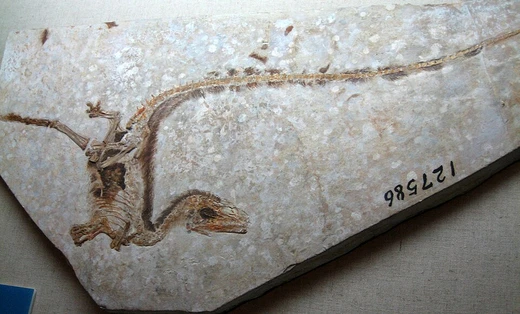
Deinonychus
A small, agile predator that reshaped dinosaur science.

Deinonychus (dy-NON-ih-kəs; from Ancient Greek δεινός 'terrible' and ὄνυξ 'claw') is a genus of dromaeosaurid theropod dinosaur with one described species, Deinonychus antirrhopus. Fossils have been recovered from the U.S. states of Montana, Utah, Wyoming, and Oklahoma, in rocks of the Cloverly Formation and Antlers Formation, though teeth that may belong to Deinonychus have been found much farther east in Maryland. Paleontologist John Ostrom's study of Deinonychus in the late 1960s revolutionized the way scientists thought about dinosaurs, leading to the 'dinosaur renaissance' and igniting the debate on whether dinosaurs were warm-blooded or cold-blooded.
- scientific_name
- Deinonychus antirrhopus
- length
- Up to 3.4 meters (11 ft)
- key_fossil_localities
- Montana, Utah, Wyoming, Oklahoma, and possibly Maryland
- named_by
- John Ostrom
- year_named
- 1969
- meaning_of_name
- Terrible claw
Lore & Background
Expeditions over the following two summers uncovered more than 1,000 bones, representing at least three individuals. Ostrom and Grant E. Meyer analyzed both their own material and Brown's 'Daptosaurus' and found them to be the same species, which Ostrom officially named Deinonychus antirrhopus in February 1969. The specific name 'antirrhopus' means 'counterbalancing' and refers to the likely purpose of a stiffened tail.
Reader's Guide
Ostrom's description of Deinonychus in 1969 has been described as the most important single discovery of dinosaur paleontology in the mid-20th century. The discovery of this clearly active, agile predator did much to change the scientific and popular conception of dinosaurs, which had previously been seen as plodding, reptilian giants. Ostrom noted the small body, sleek, horizontal posture, ratite-like spine, and especially the enlarged raptorial claws on the feet, which suggested an active, agile predator. The discovery also ignited the debate on whether dinosaurs were warm-blooded or cold-blooded. Later study of eggshells found in close contact with gastralia suggested that Deinonychus might have brooded its eggs, implying endothermy similar to modern birds. Teeth found associated with Tenontosaurus specimens imply they were hunted or scavenged upon by Deinonychus, leading to a debate on whether Deinonychus was gregarious or solitary, with recent evidence suggesting it may have been gregarious, despite not living in mammal-like packs.
Did You Know?
- The name Deinonychus means 'terrible claw' in Ancient Greek.
- John Ostrom's study of Deinonychus in the late 1960s sparked the 'dinosaur renaissance' and the warm-blooded versus cold-blooded debate.
- Fossilized eggshells found with Deinonychus remains suggest it may have brooded its eggs, indicating endothermy similar to modern birds.
- Teeth of Deinonychus have been found closely associated with the ornithopod Tenontosaurus, implying it was hunted or scavenged.
Common Misconceptions (Editorial)
- Some people think Deinonychus was a large dinosaur, but it actually measured up to only 3.4 meters (11 feet) in length. - A common misconception is that Deinonychus was named for a specific type of claw function, but its name actually means “terrible claw” in Ancient Greek, referring to the claw itself. - It is sometimes assumed that Deinonychus was discovered as a complete genus from the start, but in reality, its fossils were initially misidentified as “Daptosaurus” before John Ostrom and Grant E. Meyer recognized them as the same species and officially named it Deinonychus antirrhopus in 1969.
Why It Matters (Editorial)
Deinonychus matters not just as another dinosaur, but as the catalyst for the “dinosaur renaissance” that fundamentally changed how scientists and the public view dinosaurs—from slow, sluggish reptiles to active, possibly warm-blooded animals related to birds. Its fossils, including eggshells hinting at brooding and teeth found with Tenontosaurus, continue to fuel debates about dinosaur behavior, metabolism, and evolution, making it a lasting touchstone in paleontology.
Frequently Asked Questions
What is Deinonychus most famous for?
It is best known for the oversized, sickle-shaped claw on each foot that inspired its 'terrible claw' name. Its compact build and nimble anatomy made it one of the first dinosaurs widely recognized as a fast, active predator rather than a sluggish, lizard-like animal.
Where have Deinonychus fossils been found?
Skeletal material has been recovered from Montana, Utah, Wyoming, and Oklahoma, mainly in the Cloverly and Antlers Formations. Teeth that may belong to the genus have also surfaced in Maryland, hinting at a broader geographic range than the western sites alone suggest.
Who named Deinonychus and when?
Paleontologist John Ostrom formally described the species in 1969 using specimens from the Cloverly Formation. His meticulous anatomical analysis of the skeleton became a landmark moment in how researchers interpreted dinosaur biology and behavior.
Why is Deinonychus important to dinosaur science?
Ostrom's 1969 study highlighted features like hollow bones, a stiffened tail, and grasping claws, directly challenging the prevailing image of dinosaurs as slow, cold-blooded lizards. That single paper is widely credited with sparking the Dinosaur Renaissance and reshaping theropod biology for decades to come.
More in Dinosaurs 1-22
Spotted an error? Know more?
This is a living reference — every entry is fact-audited, and reader corrections feed straight into our audit queue. Suggest an edit · See this site's audit record