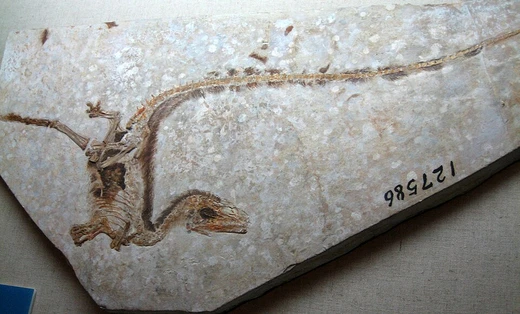
Dilophosaurus
Early Jurassic theropod with distinctive paired skull crests.

It was one of the earliest large predatory dinosaurs and the largest known land-animal in North America at the time. The genus name means 'two-crested lizard', referring to the pair of longitudinal, arched crests on its skull.
- length
- about 7 m (23 ft)
- location
- North America (Arizona)
- named_by
- Samuel P. Welles in 1970
- known_for
- being one of the earliest large predatory dinosaurs and having a pair of crests on its skull
Lore & Background
The most complete specimen became the holotype of a new species in the genus Megalosaurus, named M. wetherilli by Samuel P. Realizing it bore crests on its skull, he assigned the species to the new genus Dilophosaurus in 1970, as Dilophosaurus wetherilli. The specific name honors John Wetherill, an explorer and amateur archeologist. Dilophosaurus was slender and lightly built, with a proportionally large but delicate skull. The snout was narrow, and the upper jaw had a gap or kink below the nostril. It had a pair of longitudinal, arched crests on its skull; their complete shape is unknown, but they were probably enlarged by keratin. The teeth were long, curved, thin, and compressed sideways, with most having serrations at their front and back edges. The neck was long, and its vertebrae were hollow and very light. The arms were powerful, with a long and slender upper arm bone, and the hands had four fingers, the first bearing a large claw. The thigh bone was massive, the feet were stout, and the toes bore large claws.
Reader's Guide
Dilophosaurus has been considered a member of the family Dilophosauridae along with Dracovenator, a group placed between the Coelophysidae and later theropods, but some researchers have not found support for this grouping. It would have been active and bipedal, and may have hunted large animals; it could also have fed on smaller animals and fish. Due to the limited range of movement and shortness of the forelimbs, the mouth may instead have made first contact with prey. The function of the crests is unknown; they were too weak for battle, but may have been used in visual display, such as species recognition and sexual selection. It may have grown rapidly, attaining a growth rate of 30 to 35 kg per year early in life. The holotype specimen had multiple paleopathologies, including healed injuries and signs of a developmental anomaly. Dilophosaurus is known from the Kayenta Formation, and lived alongside dinosaurs such as Scutellosaurus and Sarahsaurus. It was designated as the state dinosaur of Connecticut based on tracks found there. Dilophosaurus was featured in the novel Jurassic Park and its movie adaptation, where it was given the fictional abilities to spit venom and expand a neck frill, and was depicted as smaller than the real animal.
Did You Know?
- The genus name Dilophosaurus means 'two-crested lizard' from Greek words di (two), lophos (crest), and sauros (lizard).
- The holotype specimen had multiple paleopathologies, including healed injuries and signs of a developmental anomaly.
- Dilophosaurus was designated as the state dinosaur of Connecticut based on tracks found there.
Common Misconceptions (Editorial)
People often think Dilophosaurus was small and able to spit venom or expand a neck frill, as depicted in popular films, but the facts confirm it was a large predator about 7 meters long, and there is no evidence in the provided record for venom or a frill. Another misconception is that Dilophosaurus had only two fingers on each hand; the record states its hands had four fingers, the first bearing a large claw.
Why It Matters (Editorial)
Dilophosaurus endures as a key figure in understanding early dinosaur evolution, representing one of the first large predatory dinosaurs to dominate North America. Its distinctive double crests and surprisingly lightweight, hollow neck vertebrae also make it a fascinating example of how specialized features evolved long before the more famous apex predators of the Jurassic and Cretaceous.
Frequently Asked Questions
What does the name Dilophosaurus mean?
The name breaks down to 'two-crested lizard,' a reference to the pair of arched, longitudinal bone crests running along the top of its skull. This distinctive feature is what sets it apart from most other early theropods.
Who named Dilophosaurus and when?
The genus was formally described by paleontologist Samuel P. Welles in 1970. His work helped establish Dilophosaurus as a distinct early theropod rather than lumping it in with other Jurassic carnivores.
More in Dinosaurs 1-22
Spotted an error? Know more?
This is a living reference — every entry is fact-audited, and reader corrections feed straight into our audit queue. Suggest an edit · See this site's audit record