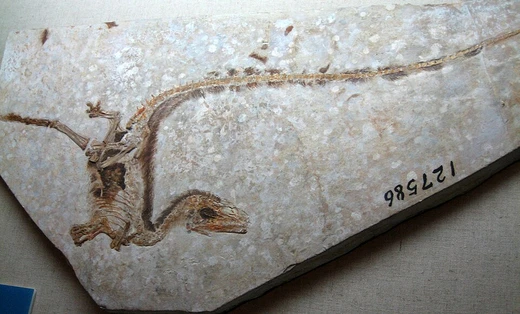
Plesiosaurus
Early Jurassic marine reptile; archetype of the plesiosaur order.

Plesiosaurus is a genus of extinct, large marine sauropterygian reptile that lived during the Early Jurassic. It is known by nearly complete skeletons from the Lias of England. Measuring around 3.5 m (11 ft) long, it is distinguishable by its small head, long and slender neck, broad turtle-like body, a short tail, and two pairs of large, elongated paddles. It lends its name to the order Plesiosauria, of which it is an early, but fairly typical member.
- field
- Paleontology
- known_for
- Archetypical genus of Plesiosauria; first complete skeleton discovered by Mary Anning
- length
- 2.87–3.5 m (9.4–11.5 ft)
- time_period
- Early Jurassic (Sinemurian)
- type_species
- Plesiosaurus dolichodeirus
Lore & Background
Additional fossils were found in rocks of the Lias Group of Dorset for many years, until the cessation of quarrying activities in the Lias Group early in the 20th century.
Reader's Guide
Plesiosaurus was one of the first of the 'antediluvian reptiles' to be discovered and excited great interest in 19th-century England. It was so-named ('near lizard') by William Conybeare and Henry De la Beche to indicate that it was more like a normal reptile than Ichthyosaurus, which had been found in the same rock strata just a few years earlier. Plesiosaurus is the archetypical genus of Plesiosauria and the first to be described, hence lending its name to the order. The type species, P. dolichodeirus, was named and described by Conybeare in 1824 on the basis of Anning's original finds. Historically, Plesiosaurus has been a wastebasket taxon, with hundreds of species assigned to it, but review of Early Jurassic species indicates that the only English species properly assigned to Plesiosaurus is P. dolichodeirus. Other species once assigned to this genus have been reassigned to new genera such as Hydrorion, Seeleyosaurus and Microcleidus.
Did You Know?
- Plesiosaurus means 'near lizard' in Greek, coined to indicate it was more like a normal reptile than Ichthyosaurus.
- Plesiosaurus had a small head, long slender neck, broad turtle-like body, short tail, and two pairs of large elongated paddles.
- The type species Plesiosaurus dolichodeirus was named and described by Conybeare in 1824 based on Anning's finds.
Common Misconceptions (Editorial)
Some people mistakenly believe that Plesiosaurus was a dinosaur or a fish, but it was actually a marine sauropterygian reptile. Another common error is that it had a snake-like neck that could coil or lift high out of the water like a Loch Ness monster; in reality, its neck was long but slender and supported by a broad, turtle-like body, and the known anatomy does not suggest such extreme flexibility or posture. Additionally, while the name “plesiosaur” is often used broadly for long-necked marine reptiles, the facts show that *Plesiosaurus* is a specific genus, with the type species *Plesiosaurus dolichodeirus* named in 1824, and it lends its name to the entire order Plesiosauria.
Why It Matters (Editorial)
*Plesiosaurus* endures as a touchstone of paleontology because its nearly complete skeletons, first uncovered by pioneering fossil hunter Mary Anning, helped establish our understanding of marine reptile evolution in the Early Jurassic. Its distinctive, almost paradoxical build—a small head on an impossibly long neck attached to a turtle-like body—continues to capture the imagination, making it a symbol of how ancient life can defy modern expectations.
Frequently Asked Questions
What is Plesiosaurus?
Plesiosaurus is a genus of large, aquatic sauropterygian reptile that swam in the oceans during the Early Jurassic. It is one of the earliest recognized members of the plesiosaur lineage and actually gave the entire order Plesiosauria its name.
What does Plesiosaurus look like?
It had a very small skull perched at the end of a long, slender neck, a broad and flattened body somewhat like a turtle's, a notably short tail, and two pairs of large, elongated flippers for propulsion through water.
How big was Plesiosaurus?
Adult specimens measured roughly 2.87 to 3.5 meters (about 9.4 to 11.5 feet) in total length. That made it a sizeable marine predator for the Early Jurassic, though considerably smaller than many later plesiosaurs.
Who discovered the first complete Plesiosaurus skeleton?
The pioneering fossil collector Mary Anning unearthed the first nearly complete skeleton in the Lias rock beds of England. Her find became one of the landmark specimens that helped establish early paleontology as a science.
Why is Plesiosaurus important to paleontology?
It serves as the type genus for the order Plesiosauria, so it acts as the baseline reference for how the group is defined. Because it represents a fairly typical early body plan, it helps researchers understand the foundational anatomy from which later, more extreme plesiosaurs evolved.
More in Dinosaurs 1-22
Spotted an error? Know more?
This is a living reference — every entry is fact-audited, and reader corrections feed straight into our audit queue. Suggest an edit · See this site's audit record